A comprehensive overview of the Brazilian judicial system, governmental structure, and regulatory environment.

Brazil has a diverse regional landscape with multiple economic and cultural hubs. Notably, several leading states concentrate the country’s main business and technology activities.

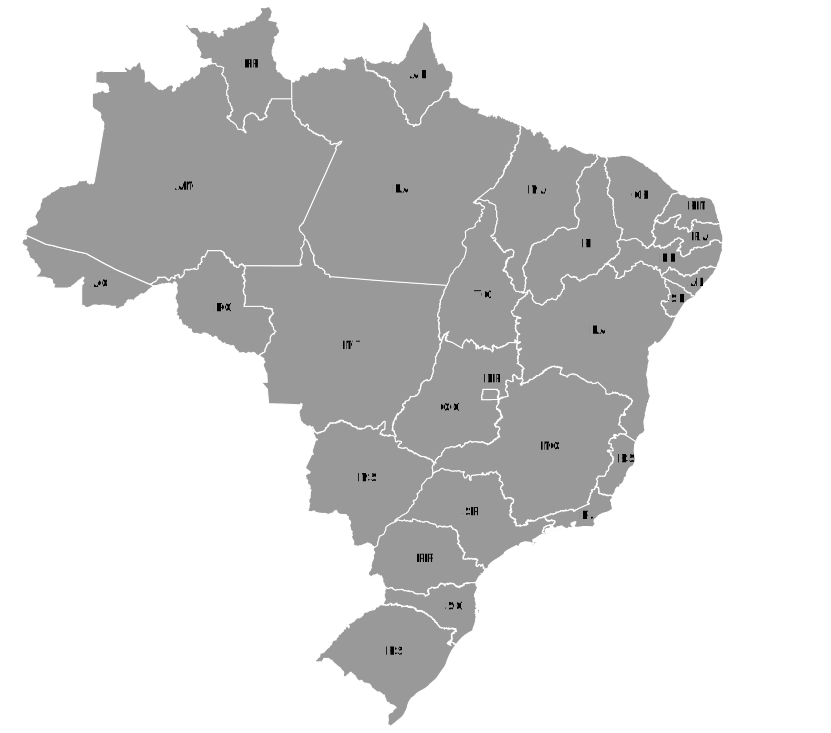
Source: IBGE. Data is approximate and may vary depending on official sources. Please refer to the Brazilian Institute of Geography and Statistics (IBGE) for the most up-to-date information

The Judiciary Branch

Brazil’s Judiciary is structured into State and Federal Courts

State Courts
Hear most disputes that arise from everyday interactions between individuals, companies, and digital services. This includes consumer lawsuits, claims for damages, contractual disputes, liability for third party content, content takedown requests, account reinstatement cases, and other conflicts connected to digital services.

Their jurisdiction is residual, meaning they handle all matters that the Constitution does not assign to the Federal Courts.
Federal Courts
Are responsible for cases involving the federal government, federal agencies, and regulatory bodies. For tech companies and digital platforms, this is typically the forum for challenging federal regulatory actions or disputing administrative sanctions.

In broad terms, State Courts handle the bulk of day-to-day disputes involving people and businesses. Federal Courts concentrate cases that involve the federal government, its agencies, and nationwide regulatory matters.

Vertical Hierarchy of the Courts
The Brazilian judicial system is structured into three levels of jurisdiction, forming a progressive judicial review framework.
First Instance
The first level consists of single judge courts (trial courts or first instance), which are responsible for hearing the parties, examining evidence, and deciding cases based on the factual record.
Second Instance
The second level comprises the appellate courts (second instance), which are panels responsible for either confirming or modifying lower courts’ rulings.
Higher Courts
At the top sit the higher courts, the Superior Court of Justice (STJ) and the Federal Supreme Court (STF).
It is strongly recommended that tech companies and digital platforms closely monitor the activities of both higher courts, because their decisions can significantly affect business operations.

Brazil’s Superior Courts: STF and STJ

Superior Court of Justice (STJ)
The STJ is composed of thirty-three justices appointed by the President and confirmed by the Senate. It serves as the court responsible for harmonizing federal law and resolving, with final authority, civil and criminal disputes that do not involve constitutional matters or specialized courts.

The STJ has ruled on a range of relevant matters for digital platforms, including corporate responsibility for personal data protection, making it clear that hacker attacks and data breaches do not, by themselves, exempt companies from liability, as well as obligations related to the retention of technical data, including users’ TCP port information. The STJ has also advanced the debate on the territorial reach of court orders directed at digital platforms in an increasingly global digital environment.
Supreme Federal Court (STF)
The STF, is composed of eleven justices, also appointed by the President and confirmed by the Senate. It is the highest court in the country and is responsible for interpreting the Constitution and resolving constitutional disputes in the final instance. Lawsuits discussing the constitutionality of State and Federal laws are also under the jurisdiction of the STF.

The STF decides constitutional matters that shape public policy and the operating environment for platforms, including freedom of expression, content moderation, liability standards, and regulatory authority. Historically, the STF has reviewed cases involving orders to block or suspend digital platforms and social networks in Brazil.

Key Features of the Brazilian Judicial System

1
Lengthy Proceedings
Judicial proceedings in Brazil frequently take years to reach a conclusion.
2
Preliminary Injunctions
Even though lawsuits often take years to conclude, Brazil has a broad system of preliminary injunctions that enable rapid decisions at the start of a case when the plaintiff is able to demonstrate a likelihood of success and risk of irreparable harm. In some cases, preliminary injunctions are decided in less than 24 hours from filing, and Judges may grant these orders even without hearing the opposing party.
3
Enforcement mechanisms
When a judge issues an urgent order requiring an immediate measure, the decision typically includes a daily fine for noncompliance. If the obligation is not fulfilled on time, the fine increases and may escalate further with continued noncompliance. Such orders may be challenged through an interlocutory appeal, which sends the matter to an appellate court panel. At this stage, the reporting appellate judge may grant staying effects, temporarily halting the injunction until the interlocutory appeal is decided.
4
Litigious
Culture
Brazil also has a highly litigious culture. Access to the courts is often simple and inexpensive, particularly in Small-Claims Courts, which generally do not require filing fees or representation by an attorney. In this context, it is common for consumers to file lawsuits for compensation for emotional distress due to issues such as failures in digital services, account suspensions, or loss of access.

CLASS ACTIONS

Class actions are another significant aspect of the Brazilian judicial system. They allow authorized entities, including the Public Prosecutor’s Office, Public Defender’s Offices, and associations, to file lawsuits on behalf of entire groups.
Collective Representation
Entities may bring legal actions on behalf of entire groups.
Collective Damages
Cases may result in substantial collective damages.
Obligations
They impose affirmative or prohibitory obligations to protect collective interests.

The Executive Branch

Brazil adopts a model of regulatory decentralization within the Executive Branch. In practice, this means that, in addition to the ministries, the country has a wide range of autonomous regulatory agencies and public authorities with technical and financial independence and the ability to issue sector‑specific norms through rules.

Ministries
Government bodies with broad responsibilities over public policies and economic sectors.
Regulatory Agencies
Autonomous entities with authority to issue sector-specific regulations through resolutions and administrative decisions.
Technical Authorities
Bodies with specialized expertise responsible for supervising and regulating specific sectors of the economy.

Key Regulators of the Digital Sector

1
Ministry of Justice and Public Security (MJSP)
The MJSP plays a central role in the country’s relationship with digital platforms and technology companies. It coordinates a significant portion of the national law‑enforcement system, including cooperation with state and federal authorities. It also leads regulatory and oversight initiatives related to public security, online crime prevention, consumer protection, and compliance with court orders. Over recent years, the MJSP has coordinated joint efforts with major platforms to address disinformation, digital crime, and safety risks.
2
Brazilian Consumer Protection Authority (SENACON)
SENACON sits under the MJSP’s umbrella, and oversees consumer relationships, launches investigations, requests information, and applies sanctions in case of violations to consumer protection laws. In the past years, the SENACON has been increasingly acting in matters involving digital environments and online platforms.
3
Brazilian Data Protection Authority (ANPD)
Another key regulator is the ANPD, which was originally created to oversee compliance with data protection rules, but has been empowered as the administrative authority responsible for matters involving digital platforms and minors’ online safety in Brazil.

Other Relevant Regulatory Agencies

Brazil also has a variety of other autonomous agencies and regulatory bodies that can affect digital platforms and technology companies.

The Legislative Branch

Brazil’s Legislative Branch operates under a bicameral structure at the federal level, which means it is divided into two legislative chambers: the House of Representatives and the Senate. Bills must be debated and approved in both chambers before being sent to the President for approval or veto.

In practice, this means that a proposal may change several times as it moves through its legislative path. It can receive amendments, undergo public hearings, and be shaped by political negotiations in different committees. This ongoing process causes legislative debates to advance or stall depending on political priorities, public pressure, and the interests of various economic sectors.

For tech companies, this dynamic is especially relevant, as there are currently several bills under discussion that could reshape rules on liability, content moderation, data protection, consumer rights, artificial intelligence, digital governance, and the protection of minors in digital environments. Indeed, this legislative environment requires continuous monitoring because the pace of deliberation can shift quickly and generate direct impacts on the operation of digital platforms and technology services.

To better understand which proposals are under debate and track their progress in Congress, please refer to our Regulatory Radar, which compiles the most relevant bills for the sector and monitors their development.


Offices